


Putting electrocatalysts to the test: Switzerland's national laboratory is operational
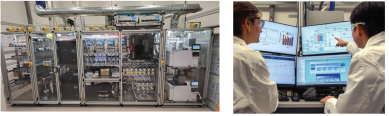
The four-parallel reactor setup (left) and control unit (right) at the NLE
A new research platform at ETH Zurich advances common testing standards and evaluates promising catalysts under industrially relevant conditions.
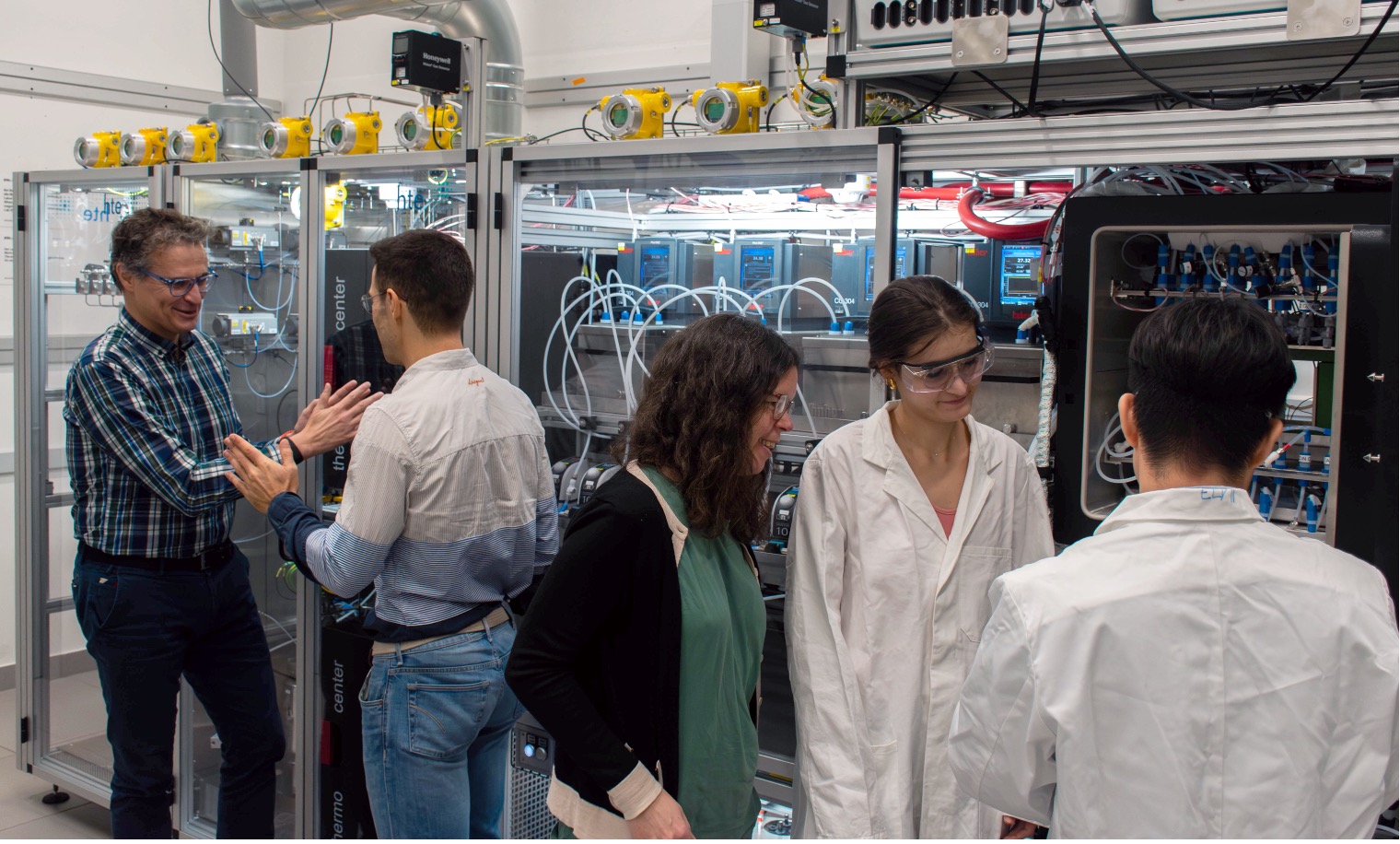
The National Laboratory of Electrocatalysis (NLE), established by NCCR Catalysis at ETH Zurich, aims to address these challenges. Now fully operational, the laboratory integrates advanced electrochemical reactors, precise operating control, and comprehensive product analysis to enable rigorous catalyst evaluation.
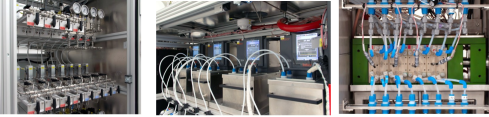
Gas control system (left), electrolyte temperature control system (middle), and the four electrocatalytic reactors in operation (right)
A central mission is to advance community standards for electrocatalyst testing. The NLE is already contributing to a collaborative effort to identify sources of experimental variability and develop reproducible testing protocols.
‘Promising catalysts often behave differently when evaluated in different electrochemical cells. The NLE allows us to understand these differences and establish more reliable comparisons,’ says Peter Broekmann, Professor at the University of Bern, who is collaborating with ETH Zurich.
Focused on CO2 electroreduction, the NLE features four parallel reactors capable of studying catalysts under industrially relevant conditions. The platform will serve as a benchmark for emerging catalysts and electrochemical systems, helping identify those with the greatest potential for practical application.
‘Electrochemistry has enormous potential for sustainable manufacturing. As a doctoral student, it is exciting to work with this advanced infrastructure and contribute to turning that potential into reality,’ says Isabelle Hengartner, doctoral researcher at ETH Zurich.
The NLE has already contributed to published research on the electrochemical conversion of CO2 into longer-chain hydrocarbons.
‘The NLE offers world-class capabilities and an exciting opportunity to connect research programs worldwide. Bringing together complementary expertise and infrastructure will be key to advancing electrochemical technologies’, says Fengwang Li, University of Sydney and GETCO2, Australia.
‘Discovering a promising catalyst is only the beginning. By combining advanced catalytic evaluation with reaction engineering, we can understand what limits performance, establish reliable benchmarks, and accelerate the development of viable electrocatalytic technologies’, says Javier Pérez-Ramírez, Director of NCCR Catalysis. ‘With the NLE, we want to establish the scientific basis for deciding which electrochemical technologies are worth pursuing’.
 tweet