

Key learnings from NCCR Catalysis Sustainability Day 2026

On 10 April 2026, NCCR Catalysis hosted its third Sustainability Day. The event brought together academic and industry experts to discuss approaches to sustainability assessment, complemented by a panel discussion that encouraged cross-disciplinary exchange. More than 110 participants joined on-site at the ETH Zurich Hönggerberg Campus and on-line via Zoom.
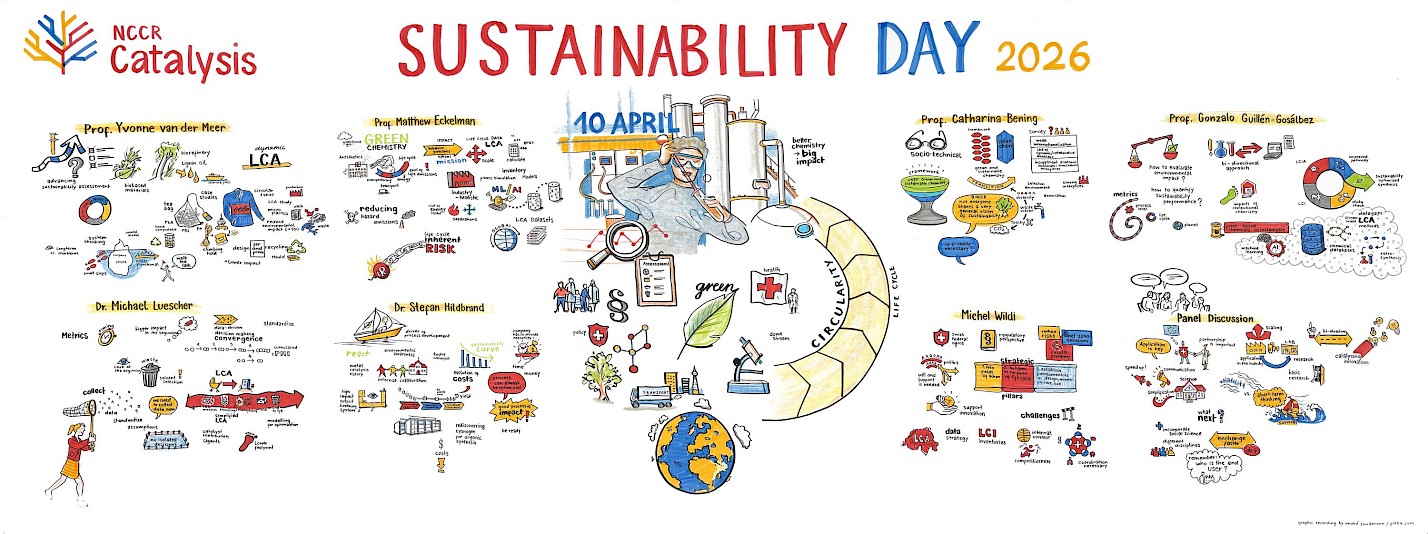
The program covered a wide range of topics focused on rethinking the chemical value chain, including systems thinking, circularity, sustainable process development and manufacturing, data availability and gaps, metrics for assessing sustainability, and the role of guidance and regulatory frameworks. Discussions also highlighted the persistent gap between scientific progress and its translation into measurable, real-world sustainability impact. Here are three key takeaways from the event.
1. Systems-level thinking as the starting point
Sustainability Day 2026 opened with a clear message: transforming chemical value chains requires a systems-level perspective. From circularity to life cycle assessment, discussions led by Prof. Yvonne van der Meer and Prof. Matthew Eckelman highlighted that sustainability must be embedded throughout the entire life cycle, from raw materials to end-of-life. This approach is central within NCCR Catalysis, where activities span the full value chain to identify more sustainable chemical production pathways. At the event, Prof. Gonzalo Guillén-Gosálbez introduced these efforts, illustrating how systems analysis can guide catalyst and process design toward broader environmental and economic goals.
2. Data and metrics remain a critical bottleneck
Industry perspectives showed how sustainability is being operationalized through metrics, data, and process design, while also revealing persistent challenges. Talks by Dr. Michael U. Luescher (Novartis) and Dr. Stefan Hildbrand (Roche) demonstrated that chemistry and catalysis are central to improving sustainability outcomes, but decisions must balance environmental impact with safety, cost, and performance. While data-driven tools are becoming more widely used, gaps remain, particularly in early-stage decision-making, where the greatest influence lies. The discussion made clear that progress depends on combining robust data with practical judgment to guide trade-offs and scale solutions effectively.
3. Closing the gap: From insight to implementation
Across the day, life cycle thinking emerged as a shared foundation, aligning perspectives from academia, industry, and policy. At the same time, Prof. Catharina Bening highlighted a persistent misalignment between sustainability frameworks and research practice, showing how NCCR Catalysis is working to better understand and bridge this gap through integrated, interdisciplinary approaches.
The panel participants agreed that earlier integration of sustainability, better data, and shared frameworks are essential to closing the gap between innovation and implementation. Programs like NCCR Catalysis play a key role in enabling this shift by connecting disciplines and stakeholders. The overall conclusion was pragmatic: advancing sustainable chemistry depends on stronger collaboration and the ability to consistently turn insight into impact.
Follow our LinkedIn page for the latest updates on upcoming events, expert talks, and featured speakers – including highlights from Sustainability Day 2026.
 tweet
tweet